Thursday, May 19, 2011

The unpalatable truth behind Manchester's football triumph


It would be a hard-hearted football fan who begrudged Manchester its double celebration at the weekend. Man U’s record 12th title under Ferguson confirms his reign as being the most dominant English football has ever seen. City finally inched out from their neighbour’s shadow with a deserved FA Cup final victory on the same day. But looking beyond the cheering crowds of delighted and relieved fans, the two triumphs represent a more sobering and disturbing truth.

City first. They bought their day in the sun. Ending the barren spell without a trophy took unheard of spending by a rich family with no prior connection whatsoever with Manchester or the football club. The winning goals in both the semi-final and final was scored by YaYa Toure, who was lured to City by a reputed £10 million a year salary. The club’s wage bill is now bigger than United’s, second only to Chelsea and clearly will never be properly sustainable – City lost £121 million last year.

Does this matter? Football’s big club prizes mostly go to the richest and why shouldn’t some nouveaux riche horn in on the trophies? If billionaires from the Gulf and Russia hadn’t come along to buy success then that probably would just have meant Man U and the “usual” big clubs would have been even more successful. Their largesse has also attracted some real superstars to the Premiership and boosted English clubs’ record in Europe. Sad to think though that clubs without a sugar daddy are seemingly doomed to play for scraps, although it should be remembered that Stoke made the Cup Final and Birmingham won the League Cup.

The red half of Manchester is celebrating a 19th league title. As ever the manager deserves huge credit for getting a far from vintage United squad over the line. Most commentators have pinpointed Wayne Rooney’s new contract in the Autumn as the turning point. The argument goes that he has made all the difference in the second half of the season and Fergie was right to give him the new contract when many – including a lot of fans – had lost patience with his sleazy antics, perceived greed and alarmingly poor form.

It’s hard to fault that analysis. Rooney has not set the Premiership alight in 2011 but has recently been effective in that space between an inconsistent midfield and an inexperienced striker (Hernandez). More importantly there is no one else that could have done the job; he has been the missing link during the title run in, although credit too belongs to the heart of defence and especially Van der Sar in goal.

So shovelling £35 million at Rooney last year was a smart piece of business but it still leaves you feeling uneasy. Here is a player who dragged his family and club through the tabloid mud, openly played his employers off against other clubs to get more money and offered up only half a season of reasonable performance (11 league goals including penalties). United fans will know that paying Rooney off was a vital part of title win number 19 but I doubt he will ever join the real legends of Old Trafford like Charlton, Robson and Giggs.

Thursday, May 12, 2011

Are Spanish private pensions a waste of money?

I have just been researching Spanish private pensions for an article on our main website ("Tax treatment of Spanish private pensions") and it left me feeling somewhat depressed. The system is supposed to encourage private pension provision by making the contributions tax free but, having dug into the topic, I wouldn't touch a Spanish pension scheme with a bargepole. How come?

If you focus solely on the tax benefits then you may well ask “what’s not to like?”. You can offset up to 10.000€ year against taxable income and you save your highest rate of tax – up to 43%. It gets even better for over-50s who can offset 12.500€ annually. But when you consider what happens once you have signed up to a pension plan and paid over your contributions, then the warm feeling generated by the tax saving starts to wear off. Here are the issues:

1) Barring some minor exceptions, your money is well and truly tied up until the normal state retirement age (65 and rising)

2) When you retire the accumulated fund can be taken as income or capital in a variety of different ways (lump sum, draw-down, annuity purchase) all of which are taxable like any other income. There used to be some tax deductions for pensions income taken from these plans but these have been scaled back.

3) Most of the pension plans I have seen charge 2% a year for administering your pension plan

Think about these drawbacks a different way – you don’t take out a personal pension plan and do your own savings. Ordinary (as opposed to pensions) savers won’t get the tax benefit of offsetting pension contributions versus taxable income and will have to pay tax on the investment income and capital gains on their savings. But on the other hand savers can invest their money themselves, avoid the 2% annual charges and draw down their savings when they like without paying income tax when they do so.


This last point is very important when comparing pension plans with ordinary savings and investments. You pay tax in both cases: pension plans save you tax initially and as you build up your returns but you pay tax when you retire on everything accumulated; ordinary savers get no tax relief to begin with and pay tax on their investment returns but don’t pay later on. You will really only gain if you pay higher rate taxes during your working life but pay the lower rate in retirement; not an uncommon situation as people mainly have lower incomes when they stop working but still food for thought. People who pay the same rate of tax pre- and post- retirement should think of pensions tax relief as “tax deferred” rather than “tax saved”.


And what about those charges? 2% may not sound so much but it is extremely significant both because it is high in terms of the returns available to most investors and because the effects are magnified over time. Additionally plan providers take a 0.5% commission on contributions as they are made to the plan. Also the underlying funds which the contributions are invested in may make charges which reduce the investment returns.


If pension plans were returning 8-10% a year, then a 2% annual management fee would not be so noticeable but when returns are down to today’s negligible levels, it makes a big difference. A 10 year government bond for example can yield as little as 2% today and the FTSE 100 yield is about 3%. Riskier assets yield considerably more but the risks to capital are greater. Inflation has recently been depressed by the recession but has been running at 3-4% in Spain. So with management charges and inflation eating away at capital, the underlying investments have to do very well (e.g. make 6%) just to stand still.


And how do the pension plans perform? Well there are literally hundreds but the ones I looked at didn’t inspire much confidence. For example La Caixa’s flagship fund “Nacional” would by my calculation have seen investments shrink by 7% (even before taking inflation into account) during the last 5 years. CajaMadrid charge 1% a year for their safest, fixed return funds but this has returned a measly 7.5% over the last 5 years, scarcely enough to cover the charges and a big loss after inflation. Their international fund (2% charge) has lost 32% in 5 years.


All in all it looks like Spanish pension plans are good for the banks who sell them but are to be treated with extreme caution by anyone who doesn’t fit a certain tax profile.

Wednesday, May 4, 2011

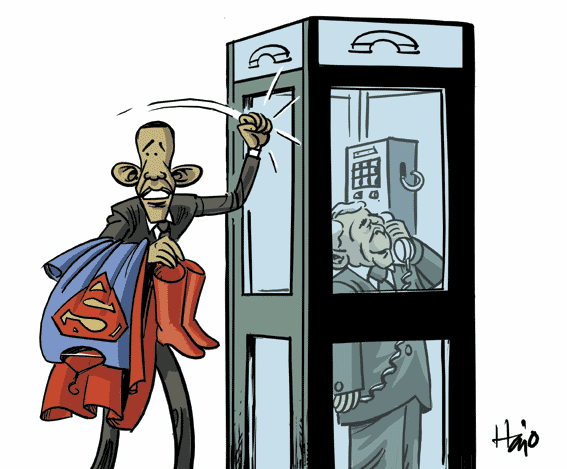
Obama´s no hero (but he could be)


The real significance of Osama Bin Laden´s demise is not so much the blow to Al Qaeda or the avenging of 9/11, it is the spotlight it has cast on the ambiguous role of Pakistan in relation to Islamic terrorism. It could be a real opportunity to shake up what has become a depressingly unproductive and pointlessly bloody campaign in the region. But many of the headlines have been grabbed by President Obama´s role and the supposed strength, courage and leadership he has shown.


It is very puzzling that he has been lionised simply for making some rather obvious decisions in his own and America´s interests. Is it so surprising that he asked his intelligence service to prioritise finding America´s biggest bogeyman since Hitler? Was it so courageous to order his special forces to kill or capture him once he was tracked down? Should we credit him or the Pentagon for the fact the raid went so smoothly from a US point of view?


It is said that he made "a gutsy call" over whether or not to send troops to the ground rather than bomb the suspected hiding place. But since a bombing would have obliterated the evidence Obama needed to show his electorate and the world, he was always going to choose the dramatic option.


Risky? Perhaps for the special ops guys going in but any soldier in the world would want to be part of such a potentially glorious mission. If it had gone wrong all Obama had to do was tick the no publicity box.


I have nothing against the man and am certainly no wild-eyed "birther", but Obama has been over-praised on this one. If he really wants to show some courage he should take on two much bigger questions both of which have been allowed to drift for too long: the war in Afghanistan, which is achieving far too little for far too much, and the aforementioned role of Pakistan.


The mission itself showed that the US has the power to project force in the region without occupying Afghanistan or giving a blank cheque to Pakistan. Time to quit letting Pakistan play the West for fools and quit Afghanistan fullstop. Now that would be courageous.


From the Advoco website: Contracting in Spain

Thursday, April 28, 2011

Spanish bureaucracy gets funny


Sorry if you have seen this before. I put it on the main website under "Autonomo : the Movie" but it is worth a look, even a second look. It´s a short film from the No Todo FilmFest (Spanish but with English subtitles) that features a young woman trying to register as autonomo and coming up against an intransigent bureaucrat. Sounds very unpromising material but actually is extremely well done and anyone who has dealt with Spain´s officialdom will agree that it is achingly true to life. Thanks to the client (an autonomo himself) who alerted me to it. It is 3 1/2 minutes long -


Our autonomo service is not quite as painful: Services for self employed / autonomos Spain


Thursday, April 21, 2011

Spanish tax form 210 - All change!

A bit of a technical post this week that will only be of much interest to non resident Spanish taxpayers. The system for paying taxes as a non resident changed on 1st April. The changes are not huge but the bureaucratic fiddling about is likely to cause some confusion.

To recap for those of you who are not familiar with Spanish non resident taxes, the tax system in Spain is a bit different to that in the UK when it comes to foreign property owners. In the UK, and most countries, a foreign property owner would only pay tax if they actually earned income in the country e.g. they rented out the house when they weren't there.

Spain taxes rental income like that but also has a quirky and irritating rule that even foreign property owners who don't rent out their property and have no Spanish income must register for and pay income tax. The tax can vary from 20-30€ up to several hundred € a year depending on the rateable value of the property. There is a full description on our main website - Spanish Tax Form 210.

The tax is still payable and the form for paying is still the same (modelo or form 210) but:

- there is no longer a paper copy of the form available so you can't go to the tax office and get a form to fill in
- you either have to complete the form online or print out a copy from the website and present it at the bank
- where there is NIL tax to pay or a return to the taxpayer then this has to be presented (or posted "certificado") at the Agencia Tributaria office
- it can now be used for whatever income non residents have, the main categories being earned income from Spanish assets (e.g. rent or dividends), capital gains and imputed income from property.
- the modelo 215 which was used for rent in the past has now been replaced by the 210
- returns of tax to a taxpayer can now be made to an overseas account (non-Spanish)

That's about it but it's a new law so as we go through the year and start doing our clients' non resident tax returns then we may learn more about how this is all going to work in practice. I will post any updates here or on the main site here: Changes to Spanish tax form 210

Thursday, April 14, 2011

Has the bears' case against Spain gone down the pan?

It was supposed to be PIGS in the plural not PIG. The smart money was betting on all the Euro area's peripheral economies buckling including Spain and not just Portugal, Ireland and Greece.
As Portugal finally opted to accept a bailout package, the headlines inevitably posed the question "Is Spain next?" The markets answered pretty emphatically "No". Ten year Spanish government bond yields stayed steady at just over 5% as they have they have done all year (for comparison the UK equivalent is around 4%). Traders and investors seem to have been reassured that Spain's economy is in better shape and crucially the government debt in relation to the Spanish economy much smaller than Portugal's (63% vs 83%).
Also the Spanish government seemed to have been shocked into action last year and made some labour market and pension reforms, put up taxes and cut spending and made a start on clearing up the mess in its banking system.
Everything OK then? Of course not, Spain is barely growing (GDP up just 0.6% last year), the banks have a lot of Portuguese debt, the housing market is still a disaster area and unemployment is shockingly high. On top of that the ECB has chosen to put up interest rates by 0.25% which feeds through to the EURIBOR rate which sets most Spanish mortgage rates. By some estimates this, and subsequent rises that the market expects to see, could add 800€ to the cost of the average mortgage. And of course there are the strikes we have seen recently and some big job cut announcements (Telefonica to cut 20% of its spanish workforce). Add in rising petrol prices and higher taxes and Spain is not a bear that is out of the woods just yet.
From the ADVOCO website: Spanish Income tax rates 2011

Thursday, April 7, 2011

The environment: capitalism to the rescue

If you are concerned about the planet's wellbeing, it would be very easy to get discouraged at the steady drip of bad news about the environment. The nuclear disasters in Japan were bad enough in themselves but the predictions that they will result in even greater demand for fossil fuels make them a double blow. Recently we had World Water Day to highlight the growing crisis around water shortages in many countries (see map here A Graphic Look at the World Water Crisis).
So where's the chink of light in the gloom? Business is normally seen as a threat to the environment; profit maximising companies plunder resources and strew the planet with waste. But there is another side to this: capitalism is an essential part of the solution, with or without government legislation. I can think of at least three ways that capitalism will need to be harnessed if the world is going to grow sustainably:
- investment. The huge sums required to build smart grids, cleaner power stations and renewable energy sources can only be mobilised efficiently by capitalism. We have seen the results of state-led investment programs before and they don't work.
- technology. Innovation and the profit motive go hand in hand. There are countless examples of this e.g. this gas from rubbish process Harvest power biogas
- recycling. Capitalism is essential to the cutting of waste. Although private decisions to use less carrier bags use the car less are important, only commercial logic can make efficiencies on the scale we need. As an example of this look at the whole business of recycling.
And what a big business it has become; and I am not just talking about cardboard and glass. One of the biggest growth businesses in recent years has been in recycling mobile phones. And the concept is spreading to all sorts of goods which can be reused rather than thrown away or left to gather dust in a cupboard, particularly baby-related and electrical products. Ebay has done a lot to promote recycling, as have websites like recycle.co.uk ("Don't bin it, recycle it!")
Spain doesn't seem to have such a big recycling community although I did find some fledgling "freecycling" groups here: http://www.freecycle.org/search
Even in Spain there are some good examples of businesses which save customers money and cut down on waste. As an example many people want a new computer but don't need anything too fancy or advanced. They can pick up a working laptop for a fraction of the price of a new one from businesses like www.reconlaptops.com.

From our website Spanish Tax Form 210
 
OctoFinder Blog and ping http://www.feeds4all.nl Spanish Insight - Blogged