Wednesday, May 4, 2011

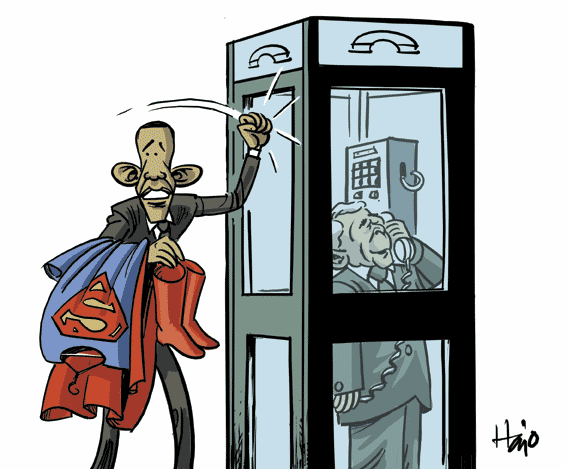
Obama´s no hero (but he could be)


The real significance of Osama Bin Laden´s demise is not so much the blow to Al Qaeda or the avenging of 9/11, it is the spotlight it has cast on the ambiguous role of Pakistan in relation to Islamic terrorism. It could be a real opportunity to shake up what has become a depressingly unproductive and pointlessly bloody campaign in the region. But many of the headlines have been grabbed by President Obama´s role and the supposed strength, courage and leadership he has shown.


It is very puzzling that he has been lionised simply for making some rather obvious decisions in his own and America´s interests. Is it so surprising that he asked his intelligence service to prioritise finding America´s biggest bogeyman since Hitler? Was it so courageous to order his special forces to kill or capture him once he was tracked down? Should we credit him or the Pentagon for the fact the raid went so smoothly from a US point of view?


It is said that he made "a gutsy call" over whether or not to send troops to the ground rather than bomb the suspected hiding place. But since a bombing would have obliterated the evidence Obama needed to show his electorate and the world, he was always going to choose the dramatic option.


Risky? Perhaps for the special ops guys going in but any soldier in the world would want to be part of such a potentially glorious mission. If it had gone wrong all Obama had to do was tick the no publicity box.


I have nothing against the man and am certainly no wild-eyed "birther", but Obama has been over-praised on this one. If he really wants to show some courage he should take on two much bigger questions both of which have been allowed to drift for too long: the war in Afghanistan, which is achieving far too little for far too much, and the aforementioned role of Pakistan.


The mission itself showed that the US has the power to project force in the region without occupying Afghanistan or giving a blank cheque to Pakistan. Time to quit letting Pakistan play the West for fools and quit Afghanistan fullstop. Now that would be courageous.


From the Advoco website: Contracting in Spain

Thursday, April 28, 2011

Spanish bureaucracy gets funny


Sorry if you have seen this before. I put it on the main website under "Autonomo : the Movie" but it is worth a look, even a second look. It´s a short film from the No Todo FilmFest (Spanish but with English subtitles) that features a young woman trying to register as autonomo and coming up against an intransigent bureaucrat. Sounds very unpromising material but actually is extremely well done and anyone who has dealt with Spain´s officialdom will agree that it is achingly true to life. Thanks to the client (an autonomo himself) who alerted me to it. It is 3 1/2 minutes long -


Our autonomo service is not quite as painful: Services for self employed / autonomos Spain


Thursday, April 21, 2011

Spanish tax form 210 - All change!

A bit of a technical post this week that will only be of much interest to non resident Spanish taxpayers. The system for paying taxes as a non resident changed on 1st April. The changes are not huge but the bureaucratic fiddling about is likely to cause some confusion.

To recap for those of you who are not familiar with Spanish non resident taxes, the tax system in Spain is a bit different to that in the UK when it comes to foreign property owners. In the UK, and most countries, a foreign property owner would only pay tax if they actually earned income in the country e.g. they rented out the house when they weren't there.

Spain taxes rental income like that but also has a quirky and irritating rule that even foreign property owners who don't rent out their property and have no Spanish income must register for and pay income tax. The tax can vary from 20-30€ up to several hundred € a year depending on the rateable value of the property. There is a full description on our main website - Spanish Tax Form 210.

The tax is still payable and the form for paying is still the same (modelo or form 210) but:

- there is no longer a paper copy of the form available so you can't go to the tax office and get a form to fill in
- you either have to complete the form online or print out a copy from the website and present it at the bank
- where there is NIL tax to pay or a return to the taxpayer then this has to be presented (or posted "certificado") at the Agencia Tributaria office
- it can now be used for whatever income non residents have, the main categories being earned income from Spanish assets (e.g. rent or dividends), capital gains and imputed income from property.
- the modelo 215 which was used for rent in the past has now been replaced by the 210
- returns of tax to a taxpayer can now be made to an overseas account (non-Spanish)

That's about it but it's a new law so as we go through the year and start doing our clients' non resident tax returns then we may learn more about how this is all going to work in practice. I will post any updates here or on the main site here: Changes to Spanish tax form 210

Thursday, April 14, 2011

Has the bears' case against Spain gone down the pan?

It was supposed to be PIGS in the plural not PIG. The smart money was betting on all the Euro area's peripheral economies buckling including Spain and not just Portugal, Ireland and Greece.
As Portugal finally opted to accept a bailout package, the headlines inevitably posed the question "Is Spain next?" The markets answered pretty emphatically "No". Ten year Spanish government bond yields stayed steady at just over 5% as they have they have done all year (for comparison the UK equivalent is around 4%). Traders and investors seem to have been reassured that Spain's economy is in better shape and crucially the government debt in relation to the Spanish economy much smaller than Portugal's (63% vs 83%).
Also the Spanish government seemed to have been shocked into action last year and made some labour market and pension reforms, put up taxes and cut spending and made a start on clearing up the mess in its banking system.
Everything OK then? Of course not, Spain is barely growing (GDP up just 0.6% last year), the banks have a lot of Portuguese debt, the housing market is still a disaster area and unemployment is shockingly high. On top of that the ECB has chosen to put up interest rates by 0.25% which feeds through to the EURIBOR rate which sets most Spanish mortgage rates. By some estimates this, and subsequent rises that the market expects to see, could add 800€ to the cost of the average mortgage. And of course there are the strikes we have seen recently and some big job cut announcements (Telefonica to cut 20% of its spanish workforce). Add in rising petrol prices and higher taxes and Spain is not a bear that is out of the woods just yet.
From the ADVOCO website: Spanish Income tax rates 2011

Thursday, April 7, 2011

The environment: capitalism to the rescue

If you are concerned about the planet's wellbeing, it would be very easy to get discouraged at the steady drip of bad news about the environment. The nuclear disasters in Japan were bad enough in themselves but the predictions that they will result in even greater demand for fossil fuels make them a double blow. Recently we had World Water Day to highlight the growing crisis around water shortages in many countries (see map here A Graphic Look at the World Water Crisis).
So where's the chink of light in the gloom? Business is normally seen as a threat to the environment; profit maximising companies plunder resources and strew the planet with waste. But there is another side to this: capitalism is an essential part of the solution, with or without government legislation. I can think of at least three ways that capitalism will need to be harnessed if the world is going to grow sustainably:
- investment. The huge sums required to build smart grids, cleaner power stations and renewable energy sources can only be mobilised efficiently by capitalism. We have seen the results of state-led investment programs before and they don't work.
- technology. Innovation and the profit motive go hand in hand. There are countless examples of this e.g. this gas from rubbish process Harvest power biogas
- recycling. Capitalism is essential to the cutting of waste. Although private decisions to use less carrier bags use the car less are important, only commercial logic can make efficiencies on the scale we need. As an example of this look at the whole business of recycling.
And what a big business it has become; and I am not just talking about cardboard and glass. One of the biggest growth businesses in recent years has been in recycling mobile phones. And the concept is spreading to all sorts of goods which can be reused rather than thrown away or left to gather dust in a cupboard, particularly baby-related and electrical products. Ebay has done a lot to promote recycling, as have websites like recycle.co.uk ("Don't bin it, recycle it!")
Spain doesn't seem to have such a big recycling community although I did find some fledgling "freecycling" groups here: http://www.freecycle.org/search
Even in Spain there are some good examples of businesses which save customers money and cut down on waste. As an example many people want a new computer but don't need anything too fancy or advanced. They can pick up a working laptop for a fraction of the price of a new one from businesses like www.reconlaptops.com.

From our website Spanish Tax Form 210

Thursday, March 31, 2011

Are cheap holidays for pensioners such a good idea?


Did you know that the Spanish government pays for over a million pensioners to go on holiday every year? There is a program called IMERSO (Institute for Seniors Social Services) which aims to subsidise holidays for the retired community and does so on a grand scale.


The scheme is 25 years old this year and has given the chance of cheap holidays to millions of pensioners. The idea is that the state subsidises holidays within Spain (& Portugal), including travel, full board accommodation, insurance and entertainment, for anyone drawing a state pension.


The objectives are to provide a social benefit to the retired and to benefit the domestic tourist industry, particularly during the quieter months of the year. The price list is shown on the Spanish social security website and, considering it is "all inclusive", looks pretty cheap. For example, a week in Portugal for 182,70€ (per person based on two sharing). A month in the Balearic Islands for 590€.


Apparently it costs the government around 150m€ a year. Unsurprisingly travel and small business lobbyists, particularly in the tourist provinces are well in favour. They claim that the scheme actually generates a profit for government with the increased employment and tax receipts generated.


On that basis then maybe all the Spanish government needs to do is spray the subsidies around more generously. Maybe they could offer bingo subsidies or cover the cost of coaches to away football games or even arrange cheap shopping trips to Madrid and Barcelona. All these things would generate spending and commercial activity and thus boost the government coffers. Ed Balls, the Labour Shadow Chancellor, is offering a similar line of argument - more government spending "supports" the economy, promotes growth and will thus improve the public finances in the long run.


Forgive me if I don't buy into a word of this economically illiterate balderdash. Economies thrive when taxes and regulations are light; government finances thrive when they are responsibly managed and the books are balanced. Soviet-era subsidised charabang trips to the seaside are not the route to economic success.


From our website IVA Rates in Spain

Thursday, March 24, 2011

Japan quake rocks the uranium investment case

It was supposed to be another big "can't fail" commodity play like oil and precious metals, but since the Japan earthquake sent powerful shocks through the nuclear power industry investors who bought into uranium have cause to regret.

Before the horrendous disaster in Japan and the subsequent radiation leaks, I was seriously thinking of getting some, er, exposure to uranium. The bull case seemed pretty much irrefutable the more I looked into it:

- emerging market energy demand is growing remorselessly

- in particular, growing car use is making it ever more likely that the oil price will go stratospheric and usher in the age of the electric car

- if the world pays any attention at all to global warming fears, some of the new generating capacity will have to be nuclear. Many countries including the UK, India and China have nuclear expansion slated.

- once nuclear power capacity is built it will consume uranium for decades - the economics and science of nuclear practically lock in demand for uranium whatever the price (as was shown in 2007 and in the 1970s when the price was more than double its current level).

- one of the key sources of uranium to supply nuclear plants today is recycled material from decommissioned warheads. This is a finite source and will need replacing by new mining within a couple of years.

Lucky I did not pile into a uranium investment such as the large Canadian producer Cameco. The uranium price fell by 27% after the nuclear emergencies in Japan became news and Cameco's share price dived. Unsurprisingly given that nuclear has always been vulnerable to safety fears and is in any case always going to be a controversial choice of new power given how expensive it is and the issues surrounding nuclear waste disposal which have never been resolved. Germany has resolved to get rid of its nuclear capacity much earlier than planned and even China has paused its building of new plants.

Some sense a buying opportunity and indeed the uranium price has since rebounded somewhat. China and India are unlikely to scrap their nuclear plans altogether and in some ways Japan was the supreme "stress test" of nuclear power: if a Chernobyl was avoided in such extreme circumstances maybe that shows they are a risk worth taking. Just don't built them on the coast in an earthquake zone!

The real long term winners will be natural gas and renewable energy investments. The disaster will also underpin the already sky high oil price. Shares such as Shell, which is expanding and gets half its output from oil and half from gas, should be good long term plays even though their share price is close to an all time high.

From the Advoco website Contracting in Spain


OctoFinder Blog and ping http://www.feeds4all.nl Spanish Insight - Blogged