Showing posts with label gordon brown. Show all posts

Thursday, June 20, 2013

Nailing left wing austerity lies

Keynesians have been in confident assertive mood recently, claiming that the facts are bearing out their long-standing calls for more fiscal stimulus to "end this recession now", as their cheerleader-in-chief Paul Krugman put it.

They claim that the divergence between US and UK growth rates proves their case.

Until Osborne choked off growth with his reckless spending cuts in 2010, they say, the UK was on the path to recovery thanks to Labour's loose fiscal policy, including a temporary VAT cut.  The chickens of austerity are now coming home to roost, including a stubbornly persistent deficit.

Contrast this with the US, where Obama resisted calls to start cutting the deficit, and a recovery is gathering strength.

This Observer article is typical of the breed:

Gordon Brown at the helm, steered the world economy back on course, with the aid of a $1 trillion collective stimulus. Brown wanted to maintain the stimulus: the US government did, but the 2010 coalition did not, in the name of budgetary consolidation. The US budget position improved dramatically with economic growth while the British deficit, in the absence of decent growth, continues to be an embarrassment.

The problem is that the figures don't support this version of events.  Look at the chart showing UK and US public sector deficits as a % of GDP:


The supposed difference between austerity-obsessed Brits and spendthrift Yanks is all rhetoric and perception.  If anything the US has adopted a tighter fiscal policy than the graph suggests: there have been big cuts at state level which are not reflected in the Federal deficits shown here.

The reality is that the two countries have followed a very similar path.  They entered the recession with their public finances in remarkably poor shape given the boom that preceded it and the crisis sent deficits soaring.

Both started out with some Keynesian stimulus but eased off as political concerns over the scale of borrowing took hold.  In the last couple of years both countries have adopted a middling course, neither attacking the deficit or adding to it as Krugmanites demand.

In fact the US has made the first serious move to cut deficits dramatically as their "sequestration" law kicked in this year to lop $85bn from Federal spending.  But the US is still growing more quickly than Britain.

So, the idea that British growth is slower than the US because we went for austerity and they didn't is a myth.  There are plenty of other possible explanations for the US currently outperforming Britain.

I would highlight one - US house prices were allowed to fall back to their pre-boom levels and the banks purged a lot of bad debt in the process.  The process is widely believed to be over and housing is now contributing to growth.  By contrast the UK has done everything in its power to prevent this house price boom unwinding and is consequently stuck in low growth mode - plateauing rather than recovering (see The stalled UK economy in one chart).

There are almost certainly multiple factors at work.  Another UK-US contrast relates to energy: they have fracking and gas prices 1/4 of UK levels, we have declining North Sea oil production shaving a % point off GDP.

One thing's for sure - the simplistic nonsense about "it was austerity what did it" needs to be laid to rest.


From our website:  UK and Spanish tax implications of a rental property in Spain


Tuesday, April 30, 2013

The stalled UK economy in one chart

George Osborne might have avoided Triple Dip headlines last week when the UK registered 0.3% growth, but he and everyone else knows that the economy has stalled.

Critics like the IMF and Labour point to austerity as the cause and urge him to change tack.

Others wonder why the Bank of England's monetary shock and awe, including 4 years of 0.5% interest rates and £375 bn of QE, haven't done more to create a meaningful recovery.

So why is the economy stubbornly flatlining?  Although there are a ton of possible causes from the Eurozone crisis to high oil prices, I think my little chart explains a lot.

I have plotted 13 years' worth of UK household borrowings (basically mortgages plus credit card debts) to show how quickly they rose during the Brown boom, peaked in 2008 and have wobbled around the same level ever since.

Whether you blame the government, the banks or the borrowers themselves for the reckless excesses that preceded our current recession, it was a heck of a binge.  Every year up to 2008 the private sector was borrowing around £100bn net so no wonder the economy was growing.

And it's also no surprise that it had to come to a horrible end.  House price to income ratios just got too ludicrously stretched and the debts caught up with the weaker borrowers.  So after the Brown boom, the Brown bust.

It's a familiar tale but we have seen house price-related recessions before and they end.  I am sure most people were expecting things would pick up after a couple of years as the whole cycle started again, like it did in the mid-80s and again in the early '90s.   Why not this time?

Part of the answer lies in the sheer duration and scale of the boom.  My chart shows credit expanding from 2000 but the party had got started well before.  Look at this chart of house prices:


House prices took off in the mid-90s and had already risen mightily by the turn of the century.  If we had had a recession in the early 2000s, after the dot com boom ended, then things would have turned out differently.  However the Bank of England cut interest rates and kept house prices rising to avoid a recession but at the cost of an even bigger boom and bust to come.

So that is one part of the explanation - the UK is recovering from more than your ordinary cyclical house price boom and bust.  We are struggling to emerge from a 13 year phase of two booms without a bust in between.

The other reason why bust has stubbornly failed to give way to recovery is that, in a funny way, government and Bank of England policy has been too successful since 2009.  Brown and Osborne (I think of them pretty much as one person - see Oh No! Brown and Osborne have morphed into Geordon) have both thrown everything at efforts to prevent a deflation of house prices and an unwinding of the excess debt.

In the 80s and 90s there was the pain of unemployment, repossessions, bankruptcy etc before the scene was set for recovery.  This time there has been some pain but not on a scale to clear out the effects of the boom.  Both charts, house prices and borrowings, would have to show much sharper declines to reset the economy and make a recovery feasible.

To put it bluntly the UK could, and I would argue should, have chosen to mark a clean break with the Brown boom in 2009.  This would have had involved a deeper recession for sure but at least would have cleared away the excesses of the past and set the scene for future growth.

Instead, fiscal and monetary policy aimed at making the recession as shallow and painless as possible has left  Britain unable to recover.  All the old problems - an over reliance on debt to fuel growth, outsized and inadequately capitalised banks, overstetched households, unaffordable levels of public spending - are still with us.

This explains why government policy seems so perverse at times.  Things like the diabolical Funding for Lending Scheme ("The government scheme that's crucifying savers") are desperate attempts to get back to the £100bn a year borrowing days.  And also explains why these policies will fail - people can't afford to borrow more and finance house purchases at prices which are as high as in 2008 in many areas.

Think of my chart when you listen to Osborne, the Bank of England or the Opposition.  They all chose the "shallow recession" option and should not be too surprised now that recovery seems so unattainable.


From our website:  Spanish tax forms explained


Tuesday, January 1, 2013

And winner of the worst government policy of the year is . . .


There have been plenty of contenders for the year’s worst (UK) government policy.  The coalition seems to have inherited Labour’s desire to meddle, fiddle and tweak and the uneasy marriage of Lib Dem lefties and nominally right wing Tories has been a recipe for fudge and confusion. 

This has led to a bumper crop of terrible policies including:

-          George Osborne’s “tax cuts for employment rights” policy was designed to please right wingers but was just another politician’s wheeze which backfired at the taxpayer’s expense (and confirmed that George’s scary similarity with Gordon – see “Oh No it’s Geor-don!”);

-          Ed Davey’s horrible energy bill which slaps an extra £100 onto fuel bills for a hotchpotch of measures which will damage the UK economy but do nothing to “combat climate change”.  In a world where India and China are building new coal-fired stations every week, the UK messing around with wind farms and subsidising loft insulation is an expensive irrelevance.  Davey’s bald-faced assertion that his measures will eventually reduce bills by £94 (compared to what they would have been without the bill) was political lie of the year ;

-          Separately the £2bn “climate aid” pledge to assist with climate change projects in the developing world had massive-waste-of-money written all over it;

-          The way the Treasury rowed back on the child benefit cuts for rich people was also depressing.   The original cut, announced last year, was the right thing to do but was badly botched from the start, penalising single-wage households.  The efforts to undo the damage have watered down the savings and added another huge layer of complexity to the tax system (see this if you don’t believe me see Couples face “who buys toys” quiz by taxman to get a flavour of the madness);

-          Kicking Heathrow airport expansion into the long grass (yet again) while simultaneously making UK air passenger tax the highest in the world, was a great example of political expediency trumping the long term economic interest of the country; and

-          Getting control over Labour’s crazy “open door / open wallets” immigration policy is important but the coalition have set an arbitrary target of limiting non-EU immigration and Theresa May is trying to reach it by clamping down on students from abroad and skilled workers business needs.  Leaving the EU and restricting welfare payments to citizens who have earned it would be a better bet (see EU’s migrant rules prove the referendum case).

So what could be worse than this lot?  Well my nomination as worst government policy of the year is Minimum Alcohol Pricing.  It’s at the White Paper stage now so not law but it will be soon, particularly given that the PM has thrown his weight behind it (so we can’t blame the Lib Dems for this one).  It may not be the policy with the most serious bad consequences but it is truly awful for lots of reasons which I describe here:  Minimum alcohol price: Cameron’s dodgy dossier


Wednesday, August 8, 2012

Oh no, Brown and Osborne have morphed into Geordon

They reportedly hate each other but the current and former Chancellor are increasingly merging into one.


No one was more fiercely critical of Brown as Chancellor than me and that was in the boom years as well as the the recession which followed.

I hoped George Osborne would draw a line under the Brown years and set Britain on the right course.  But increasingly it seems there is little to choose between the current Tory economic policies and the Labour ones that left the UK in ruins.

Read these five criticisms of recent Treasury policy and decide who they apply to, George or Gordon:

Out of control public sending - The Chancellor has allowed public sector spending to rise remorselessly as a % of GDP to the point where half of the UK economy is taken up by government spending, 20% of that financed by borrowing which never seems to come down, making a mockery of the "austerity" or "iron" Chancellor reputations.

Blame the foreigners - once it was the US for the sub - prime crisis which had the temerity to burst the UK's bubble and now it's the Eurozone for slowing demand for British exports.  Convenient scapegoats for a disastrous performance by the UK economy and its chancellors.

Laissez faire monetary policy - The decision to farm out responsibility for monetary policy to the Bank of England was widely-praised but it looks to me like an abrogation of responsibility.  How can you claim to be running the economy when the most important policy decisions (QE, interest rates) are made elsewhere?      The B of E has a government set inflation-target of course but this is deeply flawed and takes insufficient account of asset bubbles, money supply, the exchange rate and absolute levels of indebtedness.  The unspoken rule of the Chancellor seems to be that the B of E is free to adopt whatever monetary policy it likes . . . as long as it is loose.

Tricks and wheezes  -  There used to be a time when Chancellors announced programs which changed the face of the country - think Lawson's tax reforms in the late 80s and Healey's change of course in the late 70s.  Now we get short term fiddling and little games to try and "wrong foot" the opposition.  Lots of knockabout political point scoring and short term initiatives, nothing substantial for the long term.

As a footnote there are two members of the government who ARE making important reforms with long term economic ramifications  they are just not in No 11 (Gove - Education, Duncan Smith - Welfare).

Off balance sheet finance - why raise money transparently and honestly through the tax system when you can finance pet projects on the never never via dubious PFI schemes, Infrastructure Banks?  These schemes look like they are giving the taxpayer something for nothing but, as we are finding out with PFI-financed hospitals, they will come back to bite us in the end.

Can't decide which criticism belongs to whom?  It's because increasingly they  apply to both equally. Brown and Osborne have morphed into one terrifying being.  Heaven help us.

From our website:  Starting a business in Spain

Wednesday, April 28, 2010

Wake Up Britain!

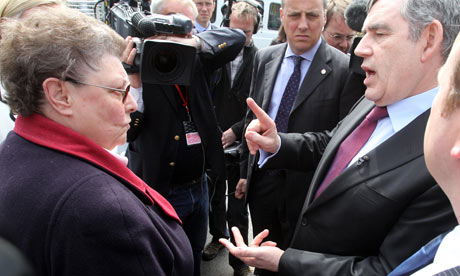
A guest post from my Dad who feels strongly feels that Britain has been too ready to accept Gordon Brown's excuses for the recession and the deficit crisis. He wrote this piece before Brown was overheard venting his ire at a (Labour) voter this morning after being all smiles to her face. But is there a connection between the two - is this a man who always has to find someone to blame? Here's the post. I agree with every word. And don't think his opinions are based on Tory bias - after a life in business his politics veer to the right but he has never been a Conservative party member or particularly vocal about politics in his life. he just feels frustrated, like I do, that Brown always seems to escape the blame for his ruinous decisions. If anyone wants to publish a defence of GB I will publish it of course.

Wake up Great Britain !

Gordon Brown has, almost single handedly , created the conditions that took the UK into a far, far worse recession than most other countries and certainly made the recession far deeper in the UK than it should ever have been.

Why did he do this ?

To make sure, as far as he was able, that he and the Labour Party were re-elected to government in the last two general elections.

How did he do this ?

He increased taxes massively, by stealth, expecting the majority of voters not to notice the seriousness of these increases, particularly the increase in taxes on pensions, which will not affect many voters for several years to come. He also allowed local councils to increase the council tax considerably in excess of inflation for many years in succession.

These measures enabled him to increase public sector expenditure, increase the number of public sector employees and increase public sector employee’s remuneration at far higher rates than inflation and at that which would have been prudent.

Result : many very happy voters in the public sector and it’s contractors and suppliers.

He allowed money supply to run out of control, at the same time he kept interest rates too low.

( EG. Interest rates after 40% tax were well below the rate of inflation, much of the time below the rates of inflation for standard rate tax payers too. ) Inflation was allowed to continue at well above the 2% per annum he set as the maximum that was sustainable. House prices soared, giving owner occupiers the ‘feel good’ factor of unexpected wealth and large sums of free equity in their properties. Freely available loans meant many owners borrowed against this free equity to buy their 4 x 4’s, larger cars, luxury cars, yachts and motor cruisers, as well their ‘dream holiday apartments’ in Spain etc.

Result : many more very happy voters.

Local authorities and banks, looking for better returns than the meagre interest rates available in the UK, looked to Iceland for better interest rates and the USA to buy ‘packages’ of loans and mortgages at higher rates of return. ( Well, so they thought ).

Banks in the UK, with the seemingly unending supply of money that was available, made irresponsible loans to house buyers and the ‘buy to let’ brigade, fuelling the runaway and booming housing market.

This resulted in the feel good factor spreading to many more voters. That was until the bubble burst and many people’s lives collapsed around them. But that came after the last general election.

Gordon Brown mismanaged the UK economy in such a gigantic way, on such a scale as has never before happened.

When everything came tumbling down around him, he, cleverly, has blamed the world recession and all of the banks for their mismanagement.

Nothing was ever the fault of Gordon Brown. Was it Gordon Brown ( with George Bush ) and his policies that caused the world recession and the global banking crisis ?

Now Gordon Brown has borrowed more money ( from where has it all come ? ) than this country has ever contemplated doing since the second world war. He is still borrowing at an enormous rate and has no intention of stopping this for many years to come, only halving the rate of borrowing after four more years of racking up massive debts for the nation.

Interest rates for investors, including pensioners in particular, are abysmal, even non taxpayers are now seeing a return on investments that are a fraction of the rate of inflation. ( My granddaughter’s small investment account paid £12.81 interest two years ago, £8.68 last year and £0.44 last week, with more money in the account each year ). However, the cheap mortgages are a boon to many borrowers, who must think Gordon Brown is a marvel, for whom they must vote again !

These are just a few of Mr Brown’s disasters. He is still giving millions away to overseas ‘ causes ‘.

Pensioners of the UK are the biggest ‘silent’ losers in Mr Brown’s debacle.

He has caused greater debts for the country than all the banks put together.

So why has not Mr Brown resigned over the catastrophe he has caused for our country ?

It is time Britain woke up and realised the horrendous damage Gordon Brown has done to the country.

After this election, I believe any incoming new government will find a far worse financial situation than has been made public to date.

However if Mr Brown can succeed in pulling the wool over the electorate’s eyes for a few more days, and passing the buck to the banks and the rest of the world, it might be him who has to admit to the country, the extremely serious situation he has got us into.

Britain, Wake up in time, do not let this last scenario happen !

Christopher Baker, Grasby, England

 
OctoFinder Blog and ping http://www.feeds4all.nl Spanish Insight - Blogged